
It is the night before the exam. You know the material, or you know it as well as you are going to. The studying is done. What is left is just the feeling: the specific mix of fear and hope and exhaustion that belongs entirely to this moment, to the version of you who has not yet found out how it goes. Record it. You will want to hear it when you get there.
The before is what the after is built on
We document achievement well. We take the photo after the result. We share the news when it is confirmed. We celebrate the arrival.
What we almost never capture is the before: the last night of uncertainty, the morning of the attempt, the moment when everything is still possible and nothing is certain. That moment vanishes the instant you find out. You can never fully return to it.
But you can leave a record of it. And that record becomes something different and more valuable than you expect.
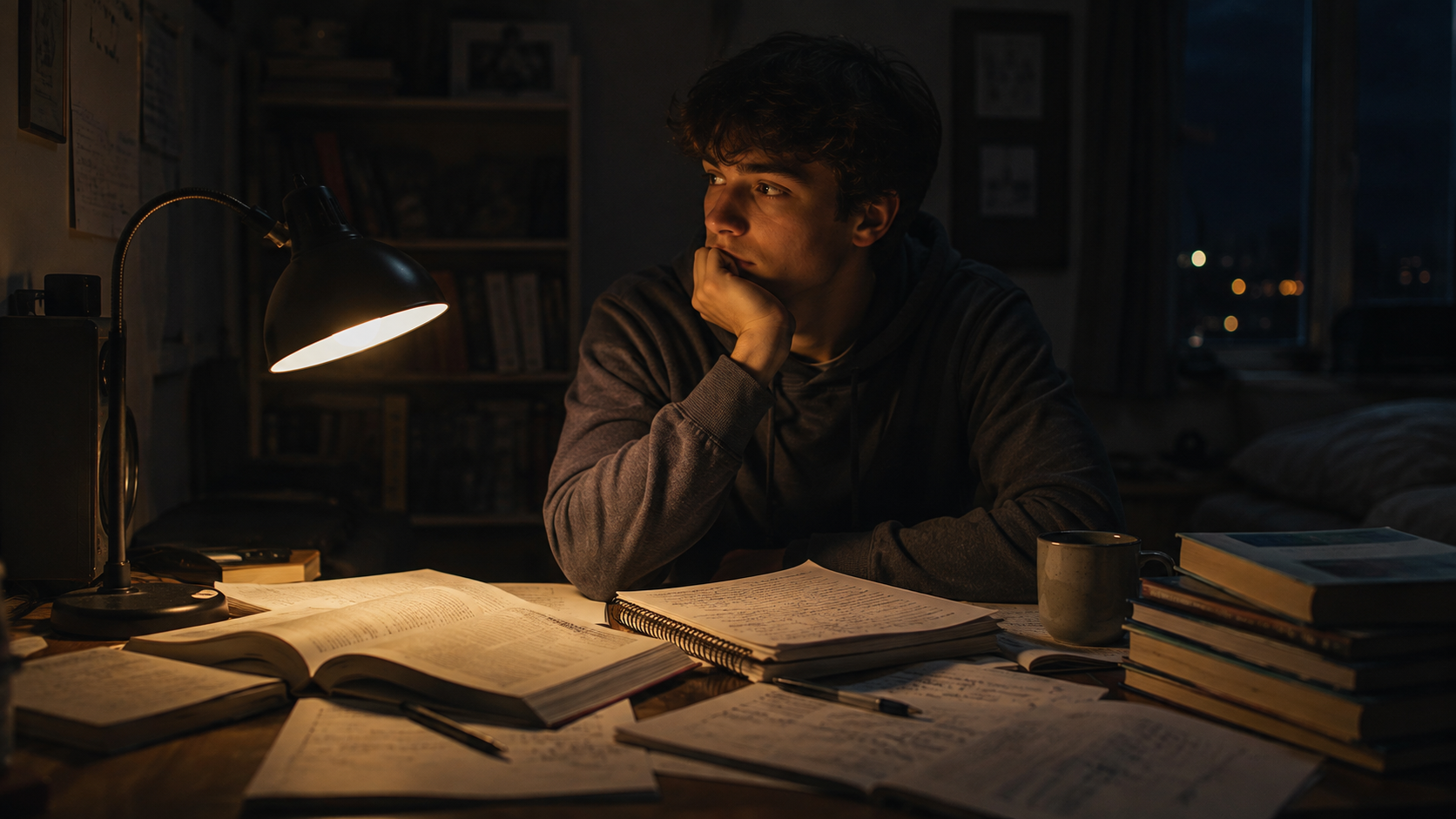
How success makes us forget the struggle
Once you have passed an exam, landed a job, or finished something hard, the difficulty of it starts to compress in memory. The months of work collapse into a general sense that it was tough. The specific fear of the night before fades. The particular uncertainty of not yet knowing becomes hard to reconstruct.
This is normal. It is how memory works. But it means that the story you tell later, about how you did something hard, is missing the most honest part: what it actually felt like before you knew you could.
A recording made the night before fills that gap. It holds the real version of the before, so the after has something to stand next to.
Your story matters beyond the result
The people who will sit where you are sitting in two years need to hear from someone who has been in that exact place. Not the polished version of events told six months later. The real-time account of the night before, when the outcome was not settled.
That kind of story travels differently. It is specific enough to be credible. It is honest enough to be comforting. It shows people what the inside of a hard moment actually looks like, not what it looks like in retrospect.
MessageFuture now supports publicly shareable links, so you can share your before-and-after as one story: the recording from the night before, played alongside the news from after. The recording is worth making now.

What psychology tells us about this moment
James Pennebaker, a psychologist at the University of Texas at Austin, spent decades studying the effects of writing about emotionally significant experiences. His research consistently found that giving language to difficult feelings, particularly in moments of uncertainty, helps people process and integrate those experiences in ways that benefit them long after the event itself.
Recording how you feel the night before something important is not self-indulgent. According to Pennebaker’s work, it is a meaningful act of self-understanding that tends to make the experience itself clearer, and its memory more durable and useful over time.
What to record tonight
Keep it simple. You do not need a script. Just speak honestly about where you are right now: what you are afraid of, what you have done to prepare, what you want the outcome to be, and what you will do either way.
Say something specific enough that your future self will remember the exact texture of this moment. Not the general fact that it was stressful. The specific detail that makes it real: the cold cup of tea you forgot to drink, the page of notes you read four times, the particular quiet of a house at midnight.
Schedule the message to arrive on the day you expect to find out. Or on the day of the goal you are working toward. Let the version of you who achieved it receive what the version who was still trying wanted to say.
MessageFuture’s FutureMe feature is built for exactly this moment. You can record tonight and choose the day it arrives. The recording takes five minutes. What it captures lasts.
Some words are worth keeping for later.
MessageFuture lets you schedule letters, voice notes, and videos for the people you love, delivered exactly when the moment comes.